Since the potential candidacy of Viktor Orbán for UN Secretary-General has become a topic of discussion, let’s talk about it for a moment. However, I should state right from the start: I cannot take the whole thing seriously, though it certainly deserves an AI-generated caricature for fun,
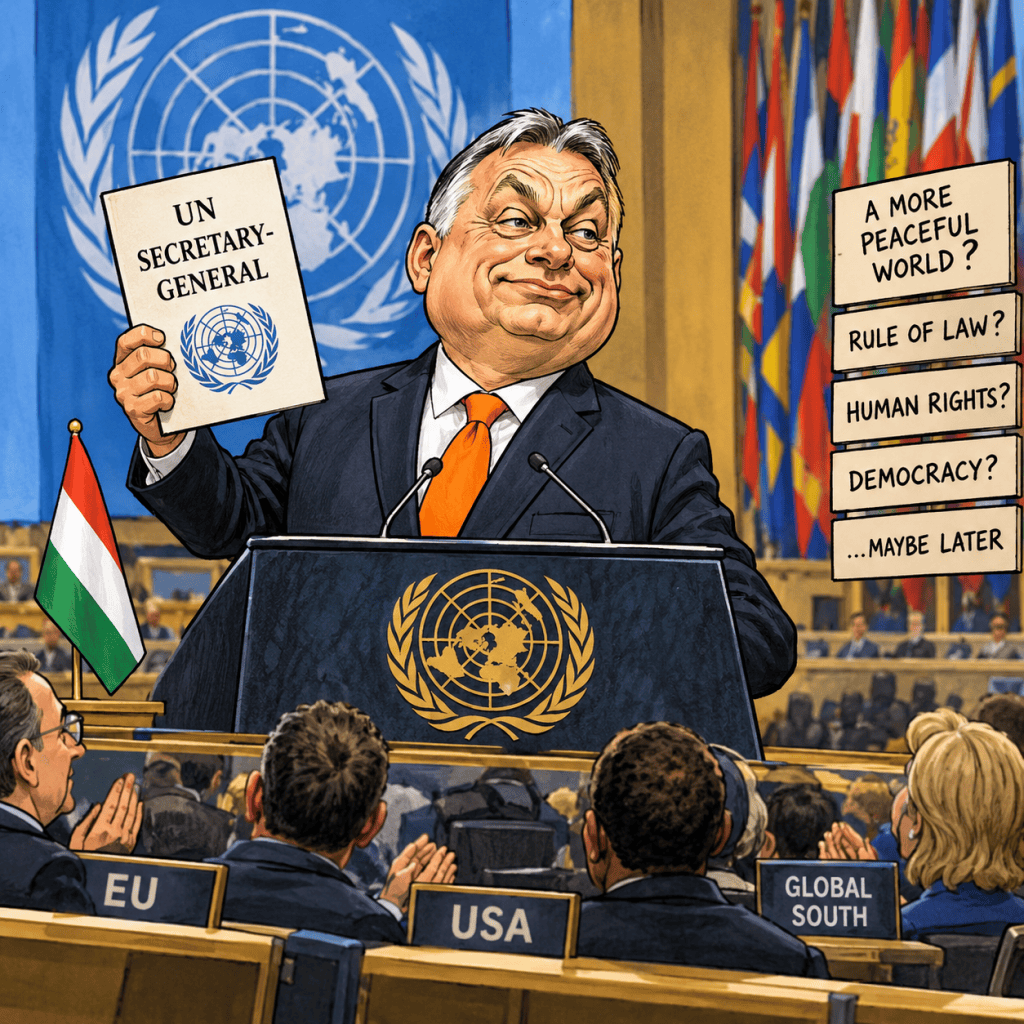
and now, let’s move on to the “serious” part:
How is the election of the UNSG made? The process is straightforward: UN member states may propose candidates who—provided they accept the nomination—submit a curriculum vitae and a so-called “vision statement.” Think of this as a manifesto outlining the future they envision for the UN. It is somewhat akin to a government or an election program. However, while candidates are free to write whatever they wish, it is questionable how much this actually matters compared to the support – or opposition – of the major powers.
The next step is the formal nomination, which takes the form of a recommendation/proposal from the UN Security Council. To secure this, a candidate must receive at least 9 affirmative votes within the 15-member Security Council, with no “no” votes from any of the five permanent members (China, France, Russia, the United Kingdom and the United States) – as such a veto would automatically disqualify the candidate. There has long been a question regarding what happens if a permanent member abstains or is absent; while the text of the UN Charter is not entirely clear – potentially implying that such instances could also count as a veto – the practice that has evolved since the Korean War is more permissive, and these are not considered being vetoes. Once the Security Council has agreed on a candidate, it communicates this to the UN General Assembly in the form of a resolution, then the General Assembly conducts the actual election. This requires a simple majority vote from the 193-member body.
It is also important to mention the principle of regional rotation: in practice, member states strive to rotate UN positions among the world’s various geographic regions, thereby aiming to comply with the UN Charter’s requirement for “equitable geographical distribution.” The Eastern European region—the so-called “Eastern European Group”—has never provided a UN Secretary-General, which would be an advantage for a Hungarian candidate.
Nevertheless, the reason I consider the whole thing a joke – to put it briefly – comes down to the following factors:
- Trump’s support does more harm than good. Furthermore, he is weak. No one takes him seriously, and following the expected debacle in the midterm elections, he will have plenty of his own problems at home. As a result of that, he will likely ramp up his anti-UN rhetoric out of desperation, meaning he will have no real influence there. We may ask the question whether it’s actually a good thing to be his friend.
- Consequently, other major powers will have no incentive to back him. One might argue that Orbán enjoys good standing with the Russians and the Chinese in his own right, but the fact is that he has failed at his domestic elections. Ergo, his value to these powers is rapidly approaching zero.
- Orbán himself is not particularly popular, and neither are the ideas he represents. Just today, everyone is celebrating the shift in Serbia—yet, only yesterday, Flávio Bolsonaro (the son of the Jair Bolsonaro, the earlier, pro-Putin president between 2019-2022) suffered a major defeat in the Brazilian presidential election. And this carries far greater global significance, especially within the Global South.
- Additionally, based on the geographical rotation: there are candidates already in the competition, some of them from LATAM, who have the same rotation-based claim to the position, not even mentioning their actual genuine relationship with the UN…
I could go on, but for now, this will suffice…

